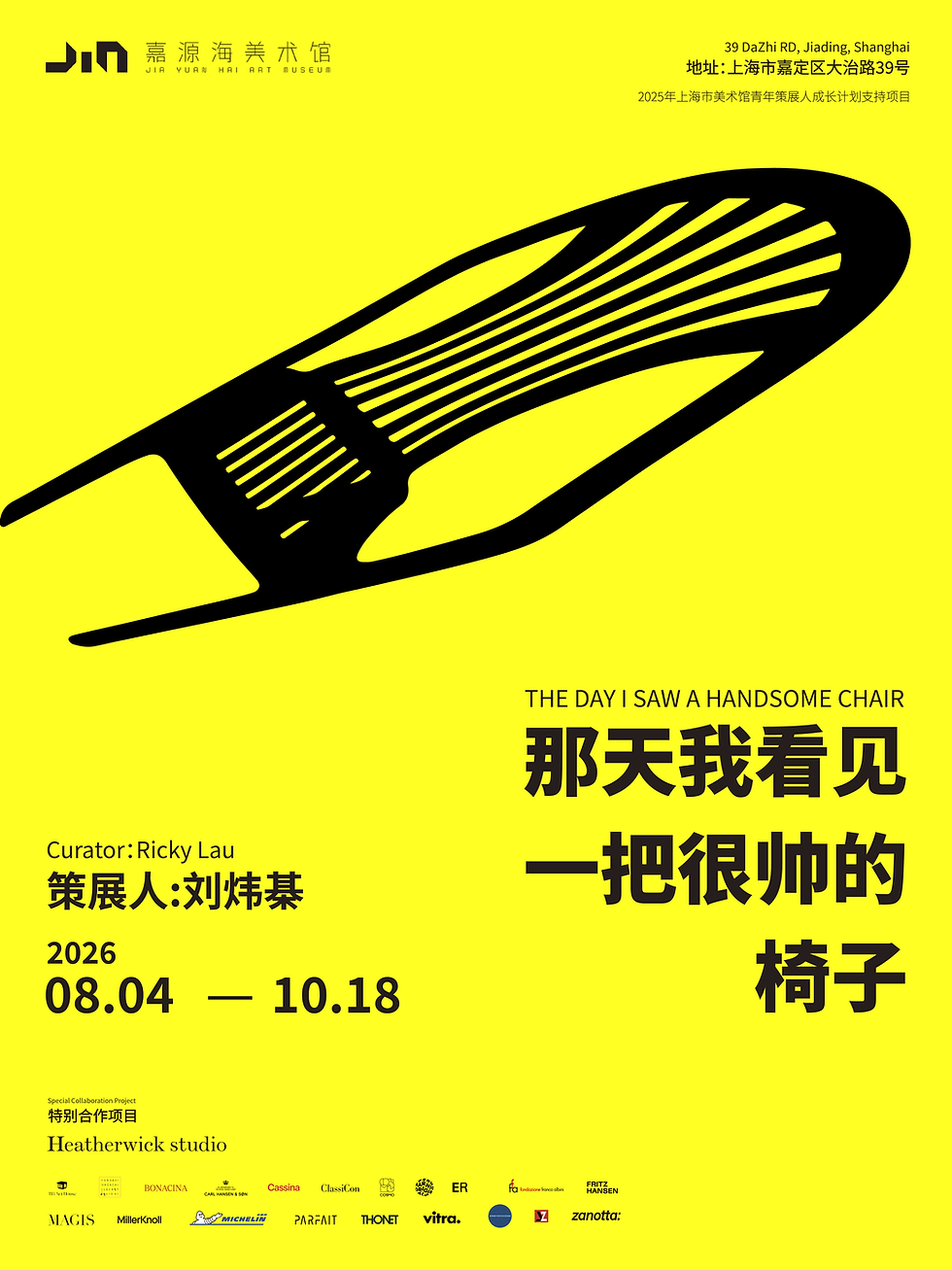
The Day I Saw a Handsome Chair
Curator:Ricky Lau
Aug 4 – Oct 18, 2026
White Plastic Chair: "Magic mirror on the wall, who is the handsomest of them all?"Magic Mirror: "Famed art thou, White Plastic Chair, for thy billions. Yet lookbeyond, fora chorus of twenty rival chairs have congregated to challenge thyhandsomethrone!"
A chair is far more than a tool of utility; it acts as an anthropomorphic mirror-reflecting shifting culture, social power, technology, and taste across millennia.Curated by Ricky Lau, the exhibition The Day I Saw a Handsome Chair at theJiayuanhai (JYH) Art Museum reveals how these everyday objects encapsulatethe spirit of theirtime. To navigate these material narratives, the curatororganizes twenty extraordinary chairs through three distinct forms of human
folklore:
Urban Myths: Chairs that arouse a sense of awe through gravity-defying and
ritualisticspectacles.
Anecdotes: Chairs embody accidental epiphanies where intimate personalhistories and chance breakthroughs permanently reconfigured everydayindustrial design.
Fairy Tale Wonderland: Chairs bound by an enchantment of fantastical and
whimsicalspells.
As one prepares to look at these handsome chairs with a renewed sense ofwonder, remember that Magic Mirror is watching: "Gaze deep into the rooms,visitors of the museum... and decide for yourselves which chair wears the
nandsomest.crown.



Curator: Ricky Lau
Ricky is a Shanghai-based design curator specialises in the history anddevelopment of 20th and 21st centuries industrial design and corporate
culture
Ricky's curatorial rationale argues that chair is the epitome of
"Zeitgeist" (German for "spirit of our time").

The Day I Saw A Handsome Chair
Heatherwick Studio
SPUN
2026
Hall Of Light
Urban Myths
Icarus’ Demise
Ricky Lau (Chinese, b. [Insert Year])
2026
ERCO New Opter LED contour spotlight, solid injection molding plastic chair
Courtesy of ERCO

Daedalus the Designer labored in his Modernist tower to solve the ultimate puzzle: how to make design truly universal. He synthesized a miraculous, lightweight white polymer. Out of this liquid, he molded a very handsome, single-body chair: Icarus White Plastic Chair.
"Go," Daedalus the Designer whispered, sending it out to democratize design. "Provide affordable chairs on earth. But beware of absolute ubiquity. Do not over-multiply, or you will crush the earth."
Icarus the Chair soared across oceans, welcomed by every hand. Thrown into the ecstasy of total global dominance, it forgot its designer's warning. It replicated by the billions, stamped out in seconds, filling every corner of the world.
But under the burning heat of relentless mass production, its value dissolved. Treated as worthless, the indestructible white mass tumbled into the sea, drowning the blue waters in an eternal, plastic grave.
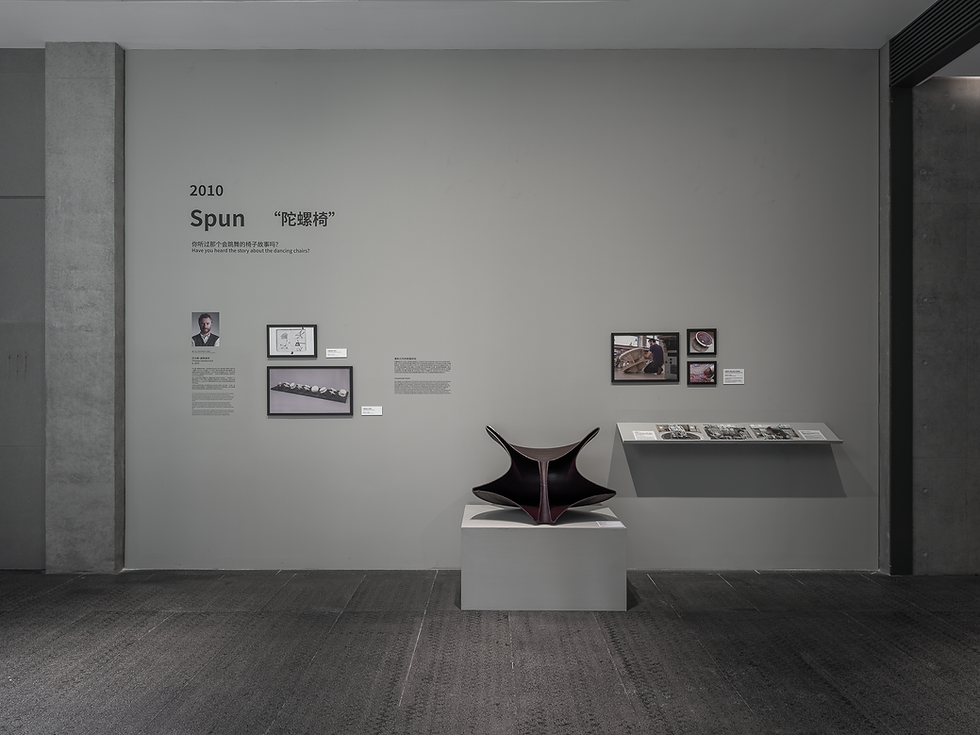
Spun Chair
Thomas Heatherwick (British, b. 1970)
Designed in 2010, current production
Rotational-moulded polyethylene
65 × 91 × 91 cm
Manufactured by Magis, Torre di Mosto, Italy
Courtesy of Heatherwick Studio and Magis

Spun began as an exploration into whether metal spinning could create a functional seat. Because the final object would be a completely symmetrical, rotational form, it needed to operate as a chair regardless of its orientation. Heatherwick Studio refined the geometry and ergonomics by testing full-scale models. The first aluminum prototype proved unexpectedly playful, rocking and rotating in three dimensions. The studio then collaborated with Italian manufacturer Magis to develop a production version using rotationally molded polyethylene. Unlike the smooth aluminum prototypes, the plastic chair features fine surface ridges—reminiscent of the grooves on a vinyl record—that prevent slipping and visually reinforce its rotational form. Released in 2010, Spun remains a celebrated design that challenges traditional seating through dynamic movement.

214 Bentwood Chair
Michael Thonet (German, 1796–1871)
Designed in 1859; this copy manufactured 2026
Solid steam-bent beechwood, woven rattan cane, and synthetic reinforcement mesh
84× 43× 52 cm, seat height 46 cm
Manufactured by Thonet GmbH, Frankenberg, Germany
Courtesy of Thonet GmbH


Chair 214 is the contemporary edition of Thonet’s iconic Chair No. 14. Formed using steam-bending technology, its solid-wood components combine visual lightness, structural strength and suitability for serial production. First designed in 1859, the chair became an enduring symbol of the industrialisation and global circulation of modern furniture.

699 Superleggera Chair
Gio Ponti (Italian, 1891–1979)
Designed in 1957, modern production
Solid ash wood and woven India cane
83 × 41 × 45 cm, seat height 46 cm
Manufactured by Cassina, Meda, Italy
Courtesy of Cassina and Ritz Design

Fairy Tale Wonderland

Déjà-vu Stool
Naoto Fukasawa (Japanese, b.1956)
Designed in 2005, current production
Extruded and die-cast polished aluminum
76 × 50 × 50 cm, seat diameter 33 cm
Manufactured by Magis, Torre di Mosto, Italy
Courtesy of Yanzhe Construction Decoration
colored pencil, and latex paint on paper
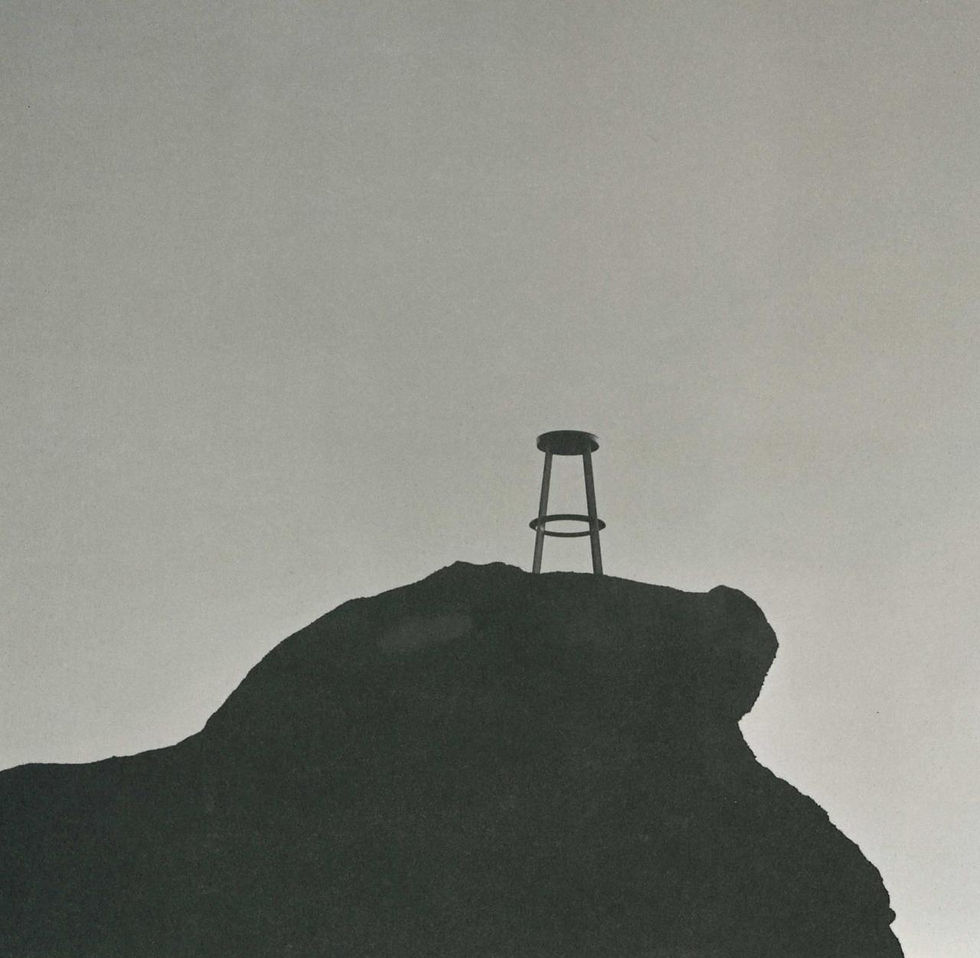

Déjà-vu is a simple stool with seat in die-cast aluminum and legs in extruded aluminum.
When the great fashion designer Issey Miyake saw the Déjà-vu stool, he was impressed by its refined elegance, he said, “Déjà-vu, the sensation of having been there before, of already having done something or met someone. Naoto Fukasawa’s design reawakens the fairy godmother, the deeply hidden memory of each of us… Naoto Fukasawa is abrilliant writer of fairy tales that create dreams which can come true at any time.”
On Fogo Island, rocks exude a red sweat. Rust is a manifestation of salt. The full moon is sometimes of a brighter red than the sun. Every night, the light that signals the entrance to the harbor blinks red. The winds, as they peel off the outer skins of the sheds and stages, also make one’s cheeks blush. My long walks are red. Now my drawings are, too.


Bubble Hanging Chair
Eero Aarnio (Finnish, b. 1932)
Designed in 1968, this copy manufactured 2026
Acrylic, stainless steel, and leather upholstery
108 × 105 × 83 cm
Manufactured by Eero Aarnio Originals, Helsinki, Finland
Courtesy of 118 Art House and Eero Aarnio Originals

Pony Seat
Eero Aarnio (Finnish, b. 1932)
Designed in 1973, this copy manufactured 2026
Tubular steel frame, moulded polyurethane foam, and fabric upholstery
87 × 110 × 65 cm
Tubular metal frame, moulded foam and stretch fabric
Courtesy of 118 Art House and Eero Aarnio Originals

Panton Chair
Verner Panton (Danish, 1926–1998)
Designed in 1957; current production
Rigid polyurethane foam with a glossy lacquer finish
83 × 50 × 60 cm, seat height 41.5 cm
Manufactured by Vitra, Birsfelden, Switzerland
Courtesy of Vitra
Anecdotes
Air-Chair
Jasper Morrison (British, b.1959)
Designed in 2000, current production
Polypropylene with glass fiber added
77.5 × 49 × 51.0 cm, seat height 47 cm
Manufactured by Magis, Torre di Mosto, Italy
Courtesy of Magis


Achille Castiglioni (Italian, 1918-2002)
Pier Giacomo Castiglioni (Italian, 1913-1968)
Designed in 1957, current production
Leather bicycle saddle, painted steel, and cast iron
Height variable 71–85 cm, base diameter 33 cm
Manufactured by Zanotta, Nova Milanese, Italy
Courtesy of Zanotta
Sella Stool
Mezzadro Stool
Achille Castiglioni (Italian, 1918-2002)
Pier Giacomo Castiglioni (Italian, 1913-1968)
Designed in 1957, current production
Lacquered seat, chromium-plated steel, and steam-treated beech wood
51 × 49 × 51 cm
Manufactured by Zanotta, Nova Milanese, Italy
Courtesy of Zanotta


Bibendum Armchair
Eileen Gray (Irish, 1878–1976)
Designed in 1926, current production
Chromium-plated tubular steel, beech frame with rubber webbing, and leather upholstery
72 × 90 × 79 cm, seat height 42 cm
Manufactured by ClassiCon, Munich, Germany
Courtesy of 118 Art House
Officina Chair
Ronan Bouroullec (French, b. 1971)
Erwan Bouroullec (French, b. 1976)
Designed in 2015; this copy manufactured 2026
Galvanized wrought iron and injection-moulded polypropylene with glass fiber
Manufactured by Magis, Torre di Mosto, Italy
80 × 58 × 54 cm, seat height 46 cm
Courtesy of Magis


Hans J. Wegner (Danish, 1914-2007)
Designed in 1949, current production
Solid wood frame and woven paper cord
76 × 55 × 51 cm, seat height 45 cm
Manufactured by Carl Hansen & Søn, Gelsted, Denmark
Courtesy of Carl Hansen & Søn
Y-Chair
Margherita Armchair
Franco Albini (Italian, 1905-1977)
Gino Colombini (Italian, 1915-2011)
Designed in 1951; produced c. 1950s
Malacca wood and Indian rattan cane
100 × 76 × 80 cm, seat height 28 cm
Manufactured by Vittorio Bonacina, Lurago d’Erba (Como), Italy
Courtesy of Studio Parfait


Franco Albini (Italian, 1905-1977)
Ezio Sgrelli (Italian, 1915-1991)
Designed in 1951; produced c. 1950s
Malacca wood and Indian rattan cane
100 × 86 × 102 cm
Manufactured by Vittorio Bonacina, Lurago d’Erba (Como), Italy
Courtesy of Studio Parfait
Gala Armchair
Stool-Tool
Konstantin Grcic (Germany, b. 1965)
Designed in 2016, current production
Polypropylene
75 × 46 × 72.5 cm
Manufactured by Vitra, Birsfelden, Switzerland
Courtesy of COSMO


Arne Jacobsen (Denmark, 1902-1971)
Designed in 1952, current production
Molded sliced walnut veneer and chrome-plated tubular steel
81 × 52 × 48 cm, seat height 46 cm
Manufactured by Fritz Hansen, Allerød, Denmark
Courtesy of Fritz Hansen
ANT™ Chair
S 33 Cantilever Chair
Mart Stam (Dutch, 1899-1986)
Designed in 1926, this copy manufactured 2026
Chrome-plated tubular steel and leather upholstery
84 × 50 × 64 cm, seat height 46 cm
Manufactured by Thonet GmbH, Frankenberg, Germany
Courtesy of Thonet GmbH and Asia-View


Mario Bellini (Italian, b. 1935)
Designed in 1977, current production
Enameled steel frame and saddle leather upholstery
82× 52 × 49 cm, seat height 45 cm
Manufactured by Cassina, Meda, Italy
Courtesy of Cassina
Cab 412 Side Chair

Begin with a midsummer of design and art
——20 Chairs, 20 Defining Decisions in Design History
Centered on the theme of "chairs", the exhibition goes beyond merely displaying iconic objects from design history, nor does it regard a chair as nothing more than an assemblage of form, material, craft and function.
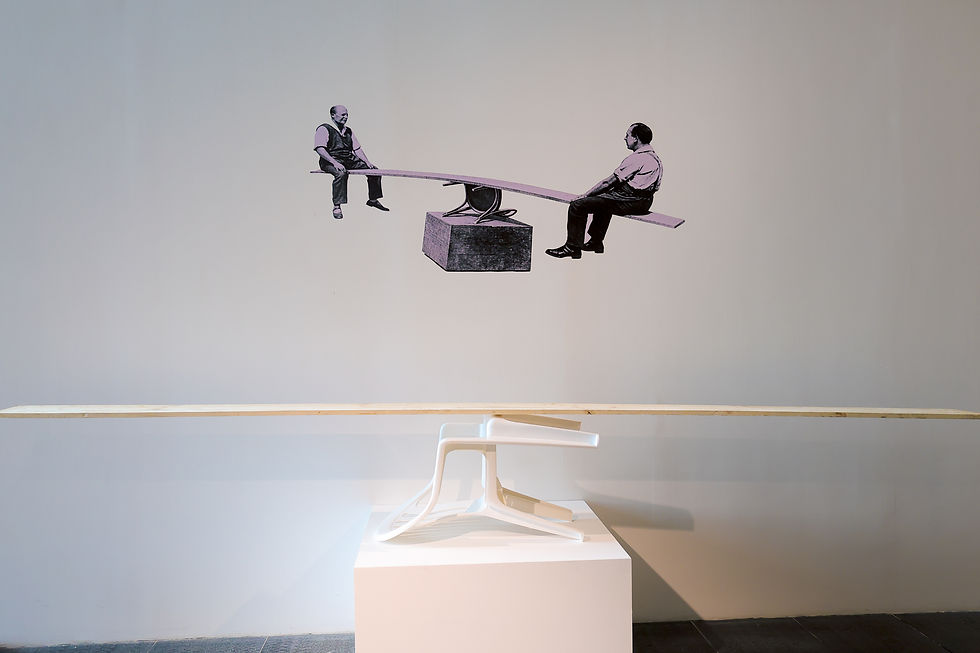
Here, the chair functions more like architecture on the smallest scale: when a person sits down, the relationship between the body and space is reconfigured. It dictates the direction of gaze, the length of stay, and bodily posture, while subtly altering the distance between people. It can serve as a place for rest or the starting point of a story; it may belong to an exhibition hall, yet also appear on street corners, in plazas, courtyards, and alongside field ridges.


Nearly every chair in the exhibition carries a compelling "legend" worth telling. The story of the Thonet No.14 chair reads like an urban myth of the industrial age: legend has it that the chair was dropped from the Eiffel Tower in Paris and landed completely intact. Using steam-bent wood technology, Michael Thonet achieved something no one dared to attempt at that time: breaking chairs down into components for ordinary people to assemble themselves. With just one wooden crate, a set of screws and a bentwood technique, this chair travelled from Vienna to the rest of the world, winning favour with figures including Lenin, Picasso, Einstein and Le Corbusier. The allure of this legend lies not merely in the chair being "unbreakable", but in its proof that great design can be both lightweight and sturdy, affordable and elegant. This marked the earliest promise of "democratic design" in the industrial era. It is far more than a chair; it represents the beginning of accessible fine design for ordinary people.




Under a Common Sky, Sheltered to Gather
2025
Under a Common Sky, Sheltered to Gather is an installation comprising ten modular pavilion-like structures that were originally commissioned and staged at the Museum Plaza of the Rockbund neighborhood as part of RAM assembles (RAMa) 2025, the biennial architecture festival presented by the Rockbund Art Museum.
Each pavilion consists of three elements—a colorful canopy of overlapping mesh fabrics that have been arranged to form a waffle shape reminiscent of the silhouette of a traditional Chinese pavilion; a lightweight steel roof structure and base frame with sand-filled metal counterweights; and fixed platforms of various heights formed from PVC sheets mounted on marine plywood boards—and can be freely assembled into different configurations of shelters and gathering places as needed.
As the central hub of RAMa 2025, Under a Common Sky was a publicly accessible social infrastructure that provided shade and seating for programmed and informal encounters throughout the duration of the festival. Following the conclusion of RAMa 2025, the installation is designed to travel and be reused, serving as a mobile spatial commons that can stimu.
Share information on a previous project here to attract new clients. Provide a brief summary to help visitors understand the context and background of the work.
Share information on a previous project here to attract new clients. Provide a brief summary to help visitors understand the context and background of the work.
