

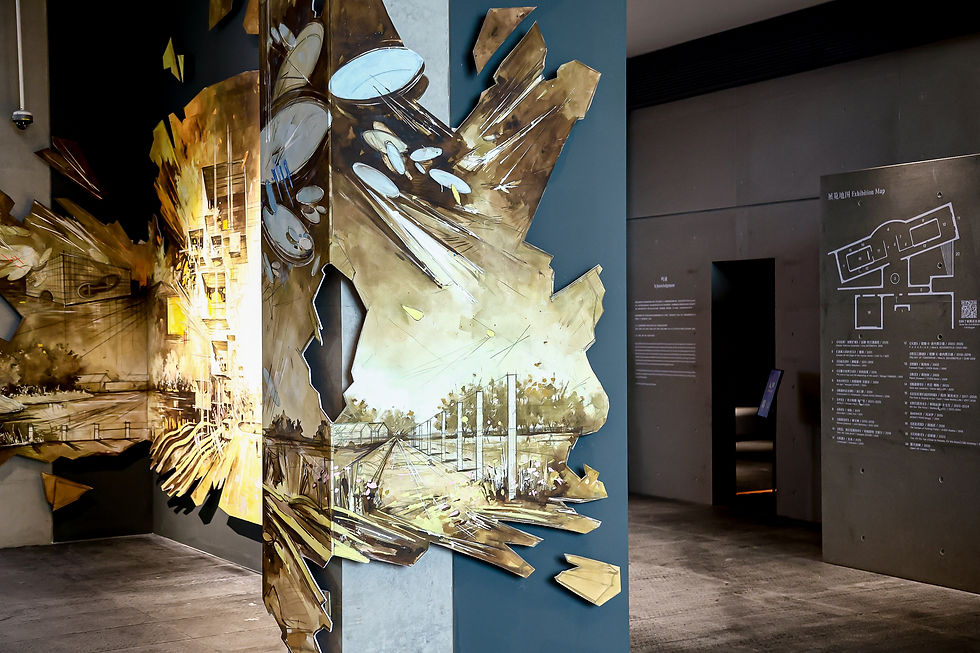
I work with transitional states -- moments when forms emerge and immediately dissolve before they have time to form properly, and at the same time something new emerges. The architecture I paint is not stable or closed - it is in motion, elastic, fragmented and in the process of being formed anew. I am interested in how our environment affects the way we think, feel and act. Modernist architecture - whether the endless high-rises of socialism or the utopian projects of the avant-garde - has always been an expression of power and worldview. But today we are at a point where these old models no longer work. The dualism between city and nature, between man and the environment, has led us to an ecological and social crisis. So in my work I ask myself: what could a new relationship between architecture and nature look like? Can architecture become a space for connection rather than separation? This work is a search for new forms of coexistence, spaces that pose questions about the past and the future and address the changing relationship between man and nature.” [Inna Artemova, June 2025]
Use this space to promote the business, its products or its services. Help people become familiar with the business and its offerings, creating a sense of connection and trust. Focus on what makes the business unique and how users can benefit from choosing it.
Use this space to promote the business, its products or its services. Help people become familiar with the business and its offerings, creating a sense of connection and trust. Focus on what makes the business unique and how users can benefit from choosing it.
For Landscapes of Futures Past, Artemova has been commissioned to make a new work – a site-specific painting installation in dialogue with both the rural landscape that surrounds the JYH Museum and the modernist ideas and drawings of its architect, Tadao Ando. Ando’s architecture is best known for fostering a deep, contemplative dialogue between built form and landscape, where landscape is an integral element in the emotional and spiritual resonance of his spaces. Time also is a focal point of his architecture, as he himself pointed out in relation to this museum: “it is hoped that the dialogue between the old and the new [I have] evoked will have the power to connect time from the past to the future.
Inna Artemova writes about her commission for the JYH Museum: “Tadao Ando's architecture does not express utopia in the usual modernist or ideological sense, like Le Corbusier or the Soviet constructivists. However, he has his own, deeply personal vision of the future, based on a spiritual architecture that can contribute to the inner transformation of man and harmony with nature. Ando sees architecture not as an instrument of power or control, but as a space for spiritual experience. His buildings are not ‘machines for living’ but environments for concentration and self-awareness. This could be considered an anti-utopia of modernist functionality and technological progress. Instead, it is a journey inwards, through light, shadow, wind, emptiness and concrete. Tadao Ando does not build utopias for the sake of a ‘new society’. His vision is an ‘anti-manifesto’ in which architecture becomes a bridge between mankind and nature. It is not a utopia that can be built, measured or imagined as a city of the future. It is a utopia of a state of being - an inner space in which humankind regains contact with itself and with nature. Ando does not seek to change the world, but to give mankind the space to change itself. His buildings speak a clear geometric language, which he relates to nature.
Utopia: Velocity Expanded
2025
acrylic marker, oil on canvas
300 x 1030 cm

ARTIST BIO: Inna ARTEMOVA
Inna Artemova (born 1972 in Moscow, USSR. Lives and works in Berlin, Germany) studied architecture at the Moscow Architectural Institute (MArchI) and received the 2nd prize of the Russian Federation for her diploma project. In 1998 she moved to Berlin and started to work as an artist in the fields of painting and drawing but her practice remained heavily influenced by the “Paper Architects“, her professors in Moscow who, from the 1980s, had developed futuristic architectural projects that were never intended to be realized. The visionary projects of the Paper Architects and her experience of migration to a city perpetually re-building itself, led Artemova to explore, through her constructivist painting style, the ideas of architectural utopias from the 1960s up to her own futuristic visions. Her recent practice as an artist has shifted from a Constructivist focus on cityscapes, to an exploration of landscape in its natural diversity – specifically on how the natural and the manmade can coexist in an ideal future. Imbued with a surreal, cinematic tension, and an explosive sense of velocity, Artemova’s paintings appear to shatter the constraints of time and space that normally bind still images on canvas. Her practice explores the limits of utopian vision: whether grand architectural speculations can withstand the forces of history, memory, and ecological crisis. These often monochromatic, storyboard-like scenes—complete with floating structures, suspended gravity, and an occasional human figure—conjure a liminal space between ambition and ruin, progress and regression.
Artemova’s work has appeared in gallery and institutional shows across Europe, Central Asia, Japan, UK, and US. Her works are held in public and private collections, reflecting her continuing influence on discourses around architecture, memory, and speculative futures. Recent major solo exhibitions include: “Becoming a Dragonfly“, Kunstverein Hockenheim, Stadthalle Hockenheim, Germany; “After Proun. Reflections on posthuman spaces“, a site specific installation at the Savitsky State Museum of Art, Nukus, Uzbekistan (2023); “Space and Vision“, Gallery Erlas, Traunkirchen, Austria (2022); “It May Sound Utopian: Agile Acceleration”, DISKURS Berlin, Germany (2021); “Landscapes of Tomorrow”, Kyrgyz National Museum of Fine Arts, Kyrgyzstan (2019); “Reinventing Utopia“, Janinebean Gallery, Berlin, Germany (2018); “No Yesterday, No Today“, Kunstverein Frankenthal, Germany(2017); “Error Codes“, gallery Börgmann, Mönchengladbach, Germany (2016).
Selected major group exhibitions include: “Preparing for Darkness , Vol. 8”, Kampa Museum of Modern Art, Prague, Czech Republic (2024); Ostrale Biennale 023: 14th International Exhibition of Contemporary Art, Dresden, Germany (2023); “DISSONANCE. Platform Germany“, Künstlerhaus Bethanien, Berlin, Germany (2022); “Danube Dialogues Contemporary Art Festival” for the European Capital of Culture Novi Sad, Sremski Karlovci, Serbia (2022); “the landscape: from arcadia to the urban“, Gallery Rosenfeld, London, UK (2021); “BETWIXT: Between Becoming and Being“ Tape Modern O54, Tacheles Culture Center, Berlin, Germany (2021); “Points of Resistance” with MOMENTUM, Zionskirche, Berlin, Germany (2021); “Ulugh Beg: Intrinsic Futuristic Machine of Central Asia”, 2nd Lahore Biennale: “Between the Sun and the Moon“, Pakistan (2020); “Bonum et Malum”, MOMENTUM & Kleiner von Wiese at Villa Erxleben, Berlin , Germany (2019); “Another World”, Deutsche Bank Collection, Frieze London, UK (2018); “Man - Cosmos!”, Biennale Worpswede, Germany (2018); “Imágines inimaginables”, Kunstverein Wasserschloss Bad Rappenau, Germany (2018); “AKKU”, Collection Paschertz, Museum Heylshof, Worms, Germany (2017); “blue bleu blau blu”, Verein Biennale, Vienna, Austria (2017); and many others.
